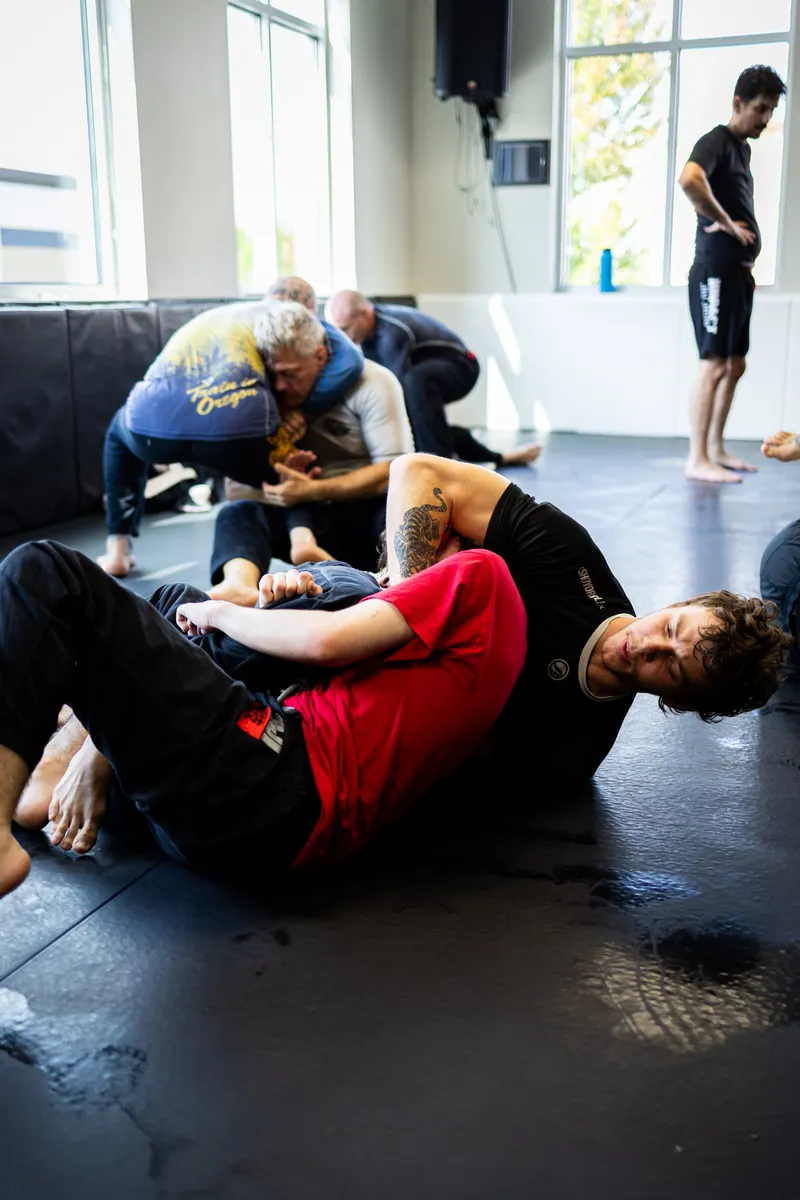
What most gyms do — and why it hits a ceiling.
Most martial arts instruction follows the same pattern: the coach demonstrates a technique, students pair up and copy it, then everyone sparring at the end. Watch, copy, repeat.
The problem is that jiu jitsu doesn't happen in a vacuum. It happens against someone who is actively trying to stop you. Skills learned in isolation — without timing, pressure, or a resisting opponent — often don't transfer to live performance.
That disconnect between "looks good in drilling" and "falls apart in sparring" is not a talent problem. It's a training design problem.
Skill is not a memorized sequence.
Ecological training treats skill as a functional relationship between you and what's happening around you — the opponent, the space, the timing, the pressure, and the opportunities those conditions create.
Instead of asking "What steps should I memorize?", it asks "What problem am I trying to solve, what is my opponent doing, and how do I adapt to make a solution work?"
Learning happens when you repeatedly interact with realistic situations and gradually become better at noticing the right information and organizing your movement to exploit what's available right now — against a resisting opponent.
"Skill is not a technique stored in your head and replayed on command. Skill is a functional relationship between you and what's happening around you."
This is not random rolling. It's structured problem design.
Instead of "memorize 12 steps to escape side control," we design a problem: your job is to create frames, win inside space, and recover guard — while your partner's job is to hold you down. You solve it. We guide the problem. You keep what works.
Games with specific goals
Every training task has a clear objective — not long technique lectures.
Constraints that guide discovery
Restricted grips, tight spaces, timed wins — constraints channel you toward functional solutions.
Live decision-making from day one
Scaled to be safe, not stripped of reality. You make real decisions from your first session.
Short, targeted coaching cues
Not long lectures between rounds — just the right nudge at the right time.
This is not only for athletes.
Beginners
You don't need simpler techniques — you need scaled, representative problems. This approach is especially good for people starting from zero.
Experienced athletes
If your development has stalled, ecological training often accelerates progress by training perception and adaptability — not just adding more techniques.
Parents
This approach is evidence-based, structured, and specifically good for youth development. It builds problem-solving and confidence — not just technique.
This is not just a philosophy.
A 2026 BJJ study (8 weeks, 4 sessions per week) reported that an ecological-dynamical training protocol produced larger improvements than a traditional method in explosive force development and reaction time, alongside reduced perceived distress.
The foundational work draws on Gibson (ecological psychology), Bernstein (motor coordination), and Newell (constraints model). Not all findings generalize to all populations. Good coaching adapts the approach to the learner.
Come experience it.
Your first class is free. No experience required. No gear needed.
Show up, introduce yourself, and see what training feels like when the method is designed for how people actually learn.